{{PopulaceWithBadges | photo = [[File:CdaSavona-coverimage.jpg|175px]] | photocaption = Caterina da Savona | location = [[Dragon's Laire]] | status = A.S. LIV (2019) | oplink = https://op.antirheralds.org/index.php?who=10759 | offices = N/A | device = [[File:CdaSavona-arms.gif|175px]] | devicecaption = Or, a triangle inverted gules within in annulo five roundels sable | badge1 = [[File:CdaSavona-RavenBadge.jpg|175px]] | badge2 = | badge3 = | badge4 = | badge5 = | badge6 =}}
{{PopulaceWithBadges | photo = [[File:CdaSavona-coverimage.jpg|175px]] | photocaption = Caterina da Savona | location = [[Dragon's Laire]] | status = A.S. LIV (2019) | oplink = https://op.antirheralds.org/index.php?who=10759 | offices = Branch Social Media Officer | device = [[File:CdaSavona-arms.gif|175px]] | devicecaption = Or, a triangle inverted gules within in annulo five roundels sable | badge1 = [[File:CdaSavona-RavenBadge.jpg|175px]] | badge2 = | badge3 = | badge4 = | badge5 = | badge6 =}}
== Persona Background ==
== Introduction ==
Born into a successful merchant family in Savona (Liguria, Italy), I was a young child when the Black Death swept through my town. It was devastating but I survived, along with my father and one of my brothers. Like the other girls from important trading families, I learned enough arithmetic, reading, and writing to help my family -- and, later, my husband -- with bookkeeping.
My name is Signora Caterina da Savona. I was born into a successful merchant family in Savona (along the coast in Liguria, west of Genoa), and I was just a child when the Black Death swept through my town. It was devastating. I survived, along with my father and one of my brothers. Like the other girls from important families in the trade, I learned enough arithmetic, reading, and writing to help my father -- and, later, my husbands -- with bookkeeping.
My husband was a kind young man, the son of our business partners in Savona. We had two children who survived to adulthood. Sadly, my husband never lived to see our second child reach majority. He was wounded during a battle at sea, against those horrible Genoese merchants. My children are married well and reside in Savona.
My first husband was a kind man, the son of an allied merchant family in Savona. We had two children who survived to adulthood. Sadly, my husband never lived to see our second child married. He was wounded during a battle at sea, against those horrible Genoese merchants. My children still live in Savona, and we see them when we travel there.
After some time, I re-married to Hugues de Bertoncourt. Now I live in his manor-house near Rethel, in France, not far from Ghent. He has a noble name, although his family is not very large. Together, we have access to Flemish woolens and Italian brocades and many other precious goods, using ships held by my family and to overland routes managed by Hugues. It is a comfortable life.
Some years after my first husband's death, I re-married to [[Hugues de Bertoncourt]], one of my brother's trade partners. Now I live in his manor-house near Rethel, in France, not far from Ghent. He has a noble name, although his family is not very large. Together, we have access to Flemish woolens and Italian brocades and many other precious goods, using ships held by my family and to overland routes managed by Hugues. It is a comfortable life.
(Caterina's registered SCA arms are inspired by medieval Italian merchant family marks, which may have been used to label boxes and crates, as well as for correspondence, etc.)
(Caterina's registered SCA arms are inspired by medieval Italian merchant family marks. Such marks may have been used to label boxes and crates, as well as for correspondence, etc.)
== SCA Interests ==
-----
I always had friends who were involved in the SCA, but I didn't jump in and try it myself until 2019 -- then we attended only three in-person events before COVID hit! I already had a background in sewing, pattern-making and tailoring, wirework, leatherworking, and fermented foods & beverages. I enjoy learning how these intersect with medieval history, technology, and culture. I have begun to dabble in narrow-ware weaving, as well.
== Arts & Sciences ==
=== Medieval Clothing Construction ===
''' 14th Century Italian & French '''
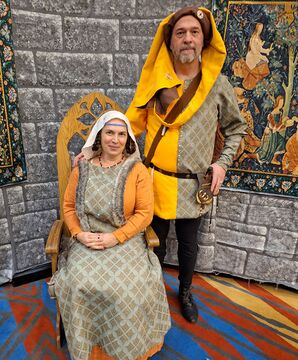
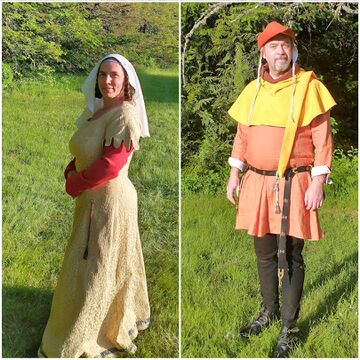
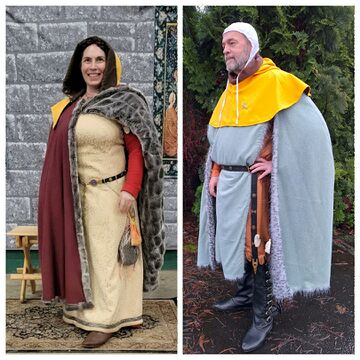
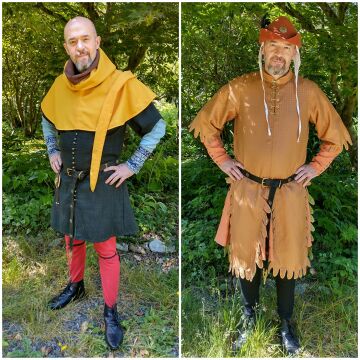
: My primary focus is continental fashion (Italian, or French with some Flemish influence) from the late 14th to early 15th century. Fabrics, styles, and accessories are chosen with the persona of "minor nobles engaged in trade" between 1385--1405. This is a fascinating time in fashion history, with exquisite tailoring, styles that changed every decade or two, and an adequate collection of surviving illuminated manuscripts, effigies, etc., to provide guidance. I strive for a head-to-toe collection of garb in a "capsule wardrobe" style, including outerwear and accessories.
=== Costuming ===
<gallery mode="packed-hover" heights=240px caption="Late 14th-century garb made by Caterina. Belts and brooches by Hugues.">
My primary focus is continental fashion (Italian, or French with some Flemish influence) from the late 14th to early 15th century. Fabrics, styles, and accessories are chosen with the persona of "minor nobles engaged in trade" in the 1380s-1390s. This is a fascinating time in fashion history, with exquisite tailoring, styles that changed every decade, and an adequate collection of surviving illuminated manuscripts, effigies, etc., to provide guidance. I strive for a head-to-toe collection of garb in a "capsule wardrobe" style.
File:CatAndHugues-12thNight2024.jpg|(click to enlarge)
File:CatAndHugues-EnA2023.jpg|(click to enlarge)
File:CatAndHugues-Ursulmas2024.jpg|(click to enlarge)
File:Hugues-FrenchAndItalian.jpg|(click to enlarge)
</gallery>
Athenaeum 2020 exhibit: [https://athenaeum.baronyofmadrone.net/exhibits/the-rise-of-fashion-italian-and-french-garb-for-1385/ The Rise of Fashion: Italian and French Garb for 1385]
: Some construction and research details are in my Athenaeum 2020 exhibit: [https://athenaeum.baronyofmadrone.net/exhibits/the-rise-of-fashion-italian-and-french-garb-for-1385/ LINK to "The Rise of Fashion: Italian and French Garb for 1385"]
: A fully lined Flemish-style "proto-doublet" gave me the footage I needed to make a series of videos on intermediate tailoring techniques for medieval clothing: [https://www.ravenswatchfarm.com/home/intermediate-sewing-tutorials LINK to "Intermediate Sewing Tutorials"]
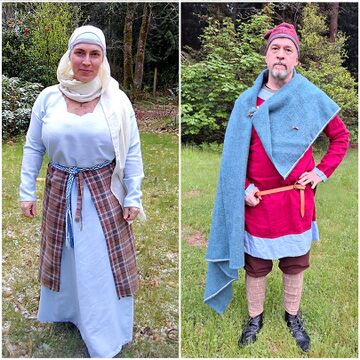
I love to teach rectangular construction and how simple it is for new sewists to dive into their first garb, so we also have Slavic clothing from the setting of the First Bulgarian Empire. (Ekaterina? LOL) These are well-off farmers/landowners, as the Bulgarian ruling class still holds sway over their culture. This was substantially more difficult to research; Slavs practiced cremation during this era and were consummate woodworkers, so little has survived from their 9th century material culture. I had to study and extrapolate from Slavic cultures before and after the time period and consider the possible effects of contact cultures.
''' 9-10th Century Southern Slavic '''
: I love to teach rectangular construction and how simple it is for new sewists to dive into their first garb, so we also have Slavic clothing from the setting of the First Bulgarian Empire. These represent well-off farmers/landowners, as the Bulgarian ruling class still holds sway over their culture.
: This culture was substantially more difficult to research. Slavs practiced cremation during this era and were consummate woodworkers, so little has survived from the early Slavic material culture. I had to study and extrapolate from Slavic cultures before and after the time period and consider the possible effects of contact cultures. Fortunately, some of these early-medieval styles appear to remain similar over centuries, not just decades.
Athenaeum 2021 exhibit: [https://athenaeum.baronyofmadrone.net/exhibits/early-medieval-slavic-garb-a-beginners-journey-into-embellishment/ Early Medieval Slavic Garb: A Beginner’s Journey into Embellishment]
: Some of the construction is detailed in my Athenaeum 2021 exhibit: [https://athenaeum.baronyofmadrone.net/exhibits/early-medieval-slavic-garb-a-beginners-journey-into-embellishment/ LINK to "Early Medieval Slavic Garb: A Beginner’s Journey into Embellishment"]
Finally, our third time period (work in progress) is a deep dive into Anatolian Greece, Ephesus 3rd-5th century BC.
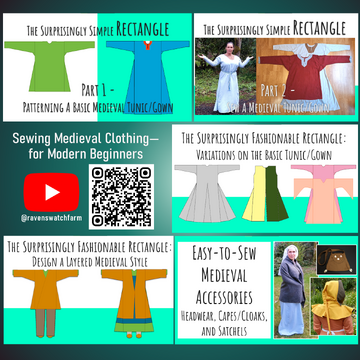
: My website hosts the online version of my rectangular construction classes, with handouts and video links: [https://www.ravenswatchfarm.com/home/rectangular-construction LINK to "Garb tutorials for beginners"]
<gallery mode="packed-hover" heights=240px>
File:CatAndHugues-10thCentury.jpg|(click to enlarge)
File:CdaSavona HowToVideos.png|(click to enlarge)
File:CdaSavona headband-templerings.jpg|(click to enlarge)
</gallery>
''' 3-5th Century BCE Greek '''
: Finally, our third time period (work in progress) is a deep dive into Anatolian Greece, Ephesus 3rd-5th century BC. I presented some of this at Dragon's Laire Harvest Feast 2024. There's a short video from the event [https://youtu.be/czThvddNi9o?feature=shared on YouTube]. You can also read my documentation [https://drive.google.com/file/d/10_gNuA1jJvy7ueIktO0dUK_TrxSsZ-O_/view?usp=drivesdk on Google docs]
: The chitons (Ionic for her, simple for him), chlamys, himation, and epiblema are materially finished, but I still want to add more details -- block printing practice is underway. I also used pickup weaving, for the first time, to create a Greek key-patterned belt. Here's a short video of me working on the weaving pattern: [https://youtube.com/shorts/2Z1l2pE37VA?si=_2OO6BbnPc7IOqdm watch it on YouTube]. Shoes and hairstyles are also on the "to do" list!
''' Weaving, Braiding, and Cordage '''
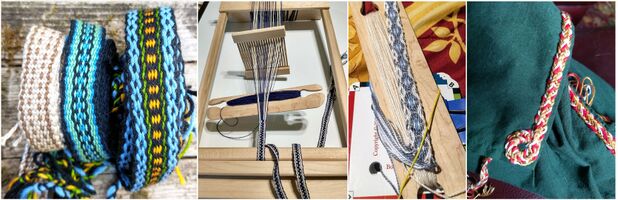
: [[File:CdaSavona-WeaveBraid.jpg|right|x200px|(click to enlarge)]] In support of costume construction, I do some narrow-band weaving. I prefer plain weaving to tablet weaving and am comfortable with cotton or wool. Fingerloop braids add a splash of color to the never-ending 14th century need for MORE ties and drawstrings. And twisted cord is a quick-and-dirty way to make longer lengths of lightweight "rope" for a variety of uses.
''' Simple Embroidery '''
: Simple embroidery in wool yarn adds a bit of "extra" to several of my pieces -- carrying bags, hoods, capes, etc. This is something I continue to add to existing pieces, time permitting.
=== Accessories in Metal and Leather ===
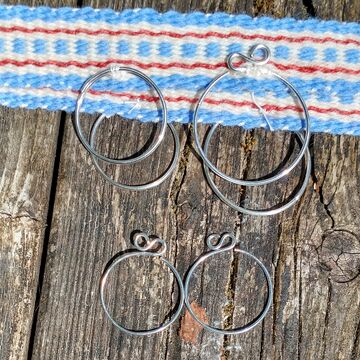
Veil pins, fibulae, belts, and sheaths, oh my! I brought my pre-existing skills in wireworking and leatherworking into my SCA hobby, and I pull them out as needed for small accessories.
=== Fermented Foods & Beverages ===
=== Fermented Foods & Beverages ===
I've been making fermented foods for many years, but it never occurred to me this piece of my mundane life would find a home in the SCA. We frequently make bread, various sourdough items, yogurt, sauerkraut, soda pop, country wines (anything but grape!), and meads. I have dabbled in cheeses but find them a bit spendy (1 lb of cheese from 1 gal milk, OUCH).
Bread & brews? The history of yeasted breads, both savory and sweet, flat and round, baked and fried, is always a source of joy. I enjoy the challenge of working with dense, whole-grain, and non-wheat flours.
But the journey that Hugues and I have taken together, in the SCA, focuses on the variety of beverages created from brewer's yeast -- from non-alcoholic sodas, to lightly alcoholic "live meads", to fruit wines and sack meads. Here's a [https://www.ravenswatchfarm.com/home/historical-fermented-beverages link to our website] with the highlights -- and copies of our class handouts with instructions and recipes.
Live meads? The sagas speak of "young mead" and "old mead", and from a variety of sources, we glean that "young meads" were drunk straight from the vat, while still sweet and bubbly. They must be drunk quickly, before it becomes more sour than sweet. When Loki receives the "old mead" in a crystal chalice, this implies a drink prized for its clarity -- suggesting that this might not be the case for young mead. Similarly, many historical mead recipes have '''very''' short fermentation times -- and instructions to drink them quickly. We've interpreted this as a "live" beverage with active yeast, about 5% residual sugar, a 5-6% ABV, and a little cloudy (just like a live ale). We have redacted several recipes, especially historical metheglins, in this style.
<blockquote>'''Did you know?''' Soda pop can be dated back at least to the 10th century!</blockquote>
It was made with yeast and honey, not chemical carbonation and sugar, but in all essentials it was soda!
We are now diving into the variety of non-alcoholic brews in the 10th century ''Annals of the Caliph's Kitchens''. And considering a side trip into vinegar brewing so we can make ancient Roman "posca" drinks.
== Affiliations ==
Apprenticed to [[Master]] [[Arion the Wanderer]].
-----
== Service ==
===Teaching ===
* Rectangular Construction 101 - Patterning & Sewing Your First Tunic/Gown [https://www.ravenswatchfarm.com/home/rectangular-construction#h.l7grnfqwb8nk (link to handout & videos)]
* Rectangular Construction 102 - The Fabulously Fashionable Rectangle [https://www.ravenswatchfarm.com/home/rectangular-construction#h.oalq6jakruro (link to handout & videos)]
* Live Meads: the Medieval Party Drink (co-taught with [[Hugues de Bertoncourt]]), [https://www.ravenswatchfarm.com/home/historical-fermented-beverages#h.m378xg19nr5r (link to handout)]
* Homemade Fermented Soda: Modern Drink, Medieval Roots [https://www.ravenswatchfarm.com/home/historical-fermented-beverages#h.l42mkf6yyjw (link to handout)]
* Knife Sharpening Basics (co-taught with [[Hugues de Bertoncourt]])
* How to Advertise Your SCA Event [https://dragonslaire.antir.org/wordpress/resources/resources-for-event-planners/how-to-advertise-your-event/ (read the article] or [https://youtu.be/NZJ6Nja1f_o?si=vxQ_7691HssG8xIN watch it on YouTube)]
===Event Support===
* Harvest Feast 2022: helped with sausage prep, made all the bread
* Harvest Feast 2023: developed a sourdough rye bread, coordinated the bread-making event, advertising lead for the event planning team
* Harvest Feast 2024: Advertising lead
* Baronial website support for June Faire in 2022, 2023, 2024
== Guilds and Group Memberships ==
===Offices===
An Tir Gardening (informal Facebook group)
* Deputy to the Baronial Webminister, [[Máenach na Cailled]], Jan 2022 -- Jan 2024
** Front-end web support and maintenance
** Newcomers welcome articles [https://dragonslaire.antir.org/wordpress/welcome/visitors/7-things-i-learned-as-a-newcomer/ LINK to "7 Things I Learned as a Newcomer to the SCA"] and [https://dragonslaire.antir.org/wordpress/welcome/visitors/guide-to-your-first-event/ "Newcomers' Guide to Your First Event"]
* Baronial Social Media Officer, Jan 2024 -- present
** Supported the creation of an unofficial branch Discord, under the administration of deputy [[Bianca di Baldasarre Saturnio]]
My name is Signora Caterina da Savona. I was born into a successful merchant family in Savona (along the coast in Liguria, west of Genoa), and I was just a child when the Black Death swept through my town. It was devastating. I survived, along with my father and one of my brothers. Like the other girls from important families in the trade, I learned enough arithmetic, reading, and writing to help my father -- and, later, my husbands -- with bookkeeping.
My first husband was a kind man, the son of an allied merchant family in Savona. We had two children who survived to adulthood. Sadly, my husband never lived to see our second child married. He was wounded during a battle at sea, against those horrible Genoese merchants. My children still live in Savona, and we see them when we travel there.
Some years after my first husband's death, I re-married to Hugues de Bertoncourt, one of my brother's trade partners. Now I live in his manor-house near Rethel, in France, not far from Ghent. He has a noble name, although his family is not very large. Together, we have access to Flemish woolens and Italian brocades and many other precious goods, using ships held by my family and to overland routes managed by Hugues. It is a comfortable life.
(Caterina's registered SCA arms are inspired by medieval Italian merchant family marks. Such marks may have been used to label boxes and crates, as well as for correspondence, etc.)
Arts & Sciences
Medieval Clothing Construction
14th Century Italian & French
My primary focus is continental fashion (Italian, or French with some Flemish influence) from the late 14th to early 15th century. Fabrics, styles, and accessories are chosen with the persona of "minor nobles engaged in trade" between 1385--1405. This is a fascinating time in fashion history, with exquisite tailoring, styles that changed every decade or two, and an adequate collection of surviving illuminated manuscripts, effigies, etc., to provide guidance. I strive for a head-to-toe collection of garb in a "capsule wardrobe" style, including outerwear and accessories.
Late 14th-century garb made by Caterina. Belts and brooches by Hugues.
A fully lined Flemish-style "proto-doublet" gave me the footage I needed to make a series of videos on intermediate tailoring techniques for medieval clothing: LINK to "Intermediate Sewing Tutorials"
9-10th Century Southern Slavic
I love to teach rectangular construction and how simple it is for new sewists to dive into their first garb, so we also have Slavic clothing from the setting of the First Bulgarian Empire. These represent well-off farmers/landowners, as the Bulgarian ruling class still holds sway over their culture.
This culture was substantially more difficult to research. Slavs practiced cremation during this era and were consummate woodworkers, so little has survived from the early Slavic material culture. I had to study and extrapolate from Slavic cultures before and after the time period and consider the possible effects of contact cultures. Fortunately, some of these early-medieval styles appear to remain similar over centuries, not just decades.
Finally, our third time period (work in progress) is a deep dive into Anatolian Greece, Ephesus 3rd-5th century BC. I presented some of this at Dragon's Laire Harvest Feast 2024. There's a short video from the event on YouTube. You can also read my documentation on Google docs
The chitons (Ionic for her, simple for him), chlamys, himation, and epiblema are materially finished, but I still want to add more details -- block printing practice is underway. I also used pickup weaving, for the first time, to create a Greek key-patterned belt. Here's a short video of me working on the weaving pattern: watch it on YouTube. Shoes and hairstyles are also on the "to do" list!
Weaving, Braiding, and Cordage
(click to enlarge) In support of costume construction, I do some narrow-band weaving. I prefer plain weaving to tablet weaving and am comfortable with cotton or wool. Fingerloop braids add a splash of color to the never-ending 14th century need for MORE ties and drawstrings. And twisted cord is a quick-and-dirty way to make longer lengths of lightweight "rope" for a variety of uses.
Simple Embroidery
Simple embroidery in wool yarn adds a bit of "extra" to several of my pieces -- carrying bags, hoods, capes, etc. This is something I continue to add to existing pieces, time permitting.
Accessories in Metal and Leather
Veil pins, fibulae, belts, and sheaths, oh my! I brought my pre-existing skills in wireworking and leatherworking into my SCA hobby, and I pull them out as needed for small accessories.
Fermented Foods & Beverages
Bread & brews? The history of yeasted breads, both savory and sweet, flat and round, baked and fried, is always a source of joy. I enjoy the challenge of working with dense, whole-grain, and non-wheat flours.
But the journey that Hugues and I have taken together, in the SCA, focuses on the variety of beverages created from brewer's yeast -- from non-alcoholic sodas, to lightly alcoholic "live meads", to fruit wines and sack meads. Here's a link to our website with the highlights -- and copies of our class handouts with instructions and recipes.
Live meads? The sagas speak of "young mead" and "old mead", and from a variety of sources, we glean that "young meads" were drunk straight from the vat, while still sweet and bubbly. They must be drunk quickly, before it becomes more sour than sweet. When Loki receives the "old mead" in a crystal chalice, this implies a drink prized for its clarity -- suggesting that this might not be the case for young mead. Similarly, many historical mead recipes have very short fermentation times -- and instructions to drink them quickly. We've interpreted this as a "live" beverage with active yeast, about 5% residual sugar, a 5-6% ABV, and a little cloudy (just like a live ale). We have redacted several recipes, especially historical metheglins, in this style.
Did you know? Soda pop can be dated back at least to the 10th century!
It was made with yeast and honey, not chemical carbonation and sugar, but in all essentials it was soda!
We are now diving into the variety of non-alcoholic brews in the 10th century Annals of the Caliph's Kitchens. And considering a side trip into vinegar brewing so we can make ancient Roman "posca" drinks.


 (click to enlarge)
 (click to enlarge)
 (click to enlarge)
 (click to enlarge)


 (click to enlarge)
 (click to enlarge)
 (click to enlarge)